How to season cast iron (and fix a sticky pan)
A cast iron skillet that's been looked after turns black and slick. One that hasn't goes tacky, patchy gray or orange with rust. Either way, an oven and an afternoon put it right, and two minutes after every wash keep it there.
By Hedgehog Chef · · 8-minute read
The quick answer
To season cast iron, wash and dry the pan, rub a very thin coat of neutral oil over every surface, wipe off as much as you can, then bake it upside down at 450 to 500°F (230 to 260°C) for 1 hour and let it cool in the oven. A sticky pan has too much oil on it: bake it again at the same heat, or scrub it back and reseason with thinner coats.
- Use vegetable oil, canola or melted shortening. Skip extra virgin olive oil for the oven bake.
- Wipe the oil off until the pan looks almost dry. Excess oil is what turns seasoning sticky.
- A new pan from the store is already seasoned, so wash it and start cooking.
- Dish soap is fine. Soaking and the dishwasher cause rust.
- After every wash, dry the pan over low heat and rub in a few drops of oil.
What is cast iron seasoning?
Seasoning is oil that's been heated until it turns into a hard, dry coating bonded to the iron. In the heat, the oil's fatty acids oxidize and link up into long chains, which chemists call polymerization. According to America's Test Kitchen's science of seasoning, the more unsaturated the oil, the more readily it does this, which is why everyday vegetable oils work so well.
The coating keeps air and water off bare iron, which rusts fast, and gives food a smoother surface to release from.
How to season cast iron in the oven
This is Lodge's method, with ATK's oil amounts: about 10 minutes of work, then an hour in the oven.
- Heat the oven to 450 to 500°F (230 to 260°C). Put a sheet of foil on the bottom rack to catch drips.
- Wash and dry. Warm, soapy water, then a towel. Set the pan on a low burner for a couple of minutes to drive off the last of the moisture.
- Oil everything. Rub oil over the inside, the outside and the handle with a paper towel. ATK uses 1 tablespoon for a 12-inch skillet and 2 teaspoons for a 10-inch.
- Wipe it off. With a clean paper towel, wipe the pan as if you'd oiled it by mistake. It should look dull and satiny with nothing pooling, and no oil should run when you tilt it.
- Bake upside down on the center rack for 1 hour, so any excess drips onto the foil instead of collecting in the bottom.
- Cool in the oven. Turn the oven off and leave the pan inside until it's cool enough to handle.
Run the hood fan: oil at this heat smokes. One round revives a pan that's gone dull. A pan scrubbed down to bare gray metal needs several, and Mississippi State University Extension repeats the process 3 to 4 times.
Recommended temperatures run from 350°F (175°C) at Mississippi State to 500°F (260°C) at ATK. Go with Lodge's 450 to 500°F, which sets the oil hard in an hour.
Tip: Step 4 decides whether you get a hard finish or a gummy one. Wiping off nearly all the oil feels wrong. Do it anyway.
What's the best oil for seasoning cast iron?
Plain vegetable oil, canola oil or melted shortening. They're cheap, neutral and full of the unsaturated fats that polymerize readily. Lodge's test kitchen reaches for vegetable or canola oil, and the factory seasoning on a new Lodge pan is a soy-based vegetable oil. ATK says any vegetable oil will work fine, sunflower, soybean and corn included.
For the oven bake, skip extra virgin olive oil and toasted sesame oil, which ATK says can burn before they polymerize. Lodge advises against seasoning with lard, tallow or ghee because they can go rancid on the pan, though cooking in them is fine.
What about flaxseed oil?
Flaxseed is the most unsaturated oil you can buy at a grocery store, and ATK's science writers say it forms a particularly durable layer. Its critics, mostly owners posting their results, report flaxseed seasoning flaking off after months of use. We couldn't find a controlled test of that either way.
We'd use canola. It's cheaper, and neither Lodge nor ATK's current seasoning guide calls for flaxseed.
How often should you season cast iron?
In the oven, only when the pan needs it: when it looks dull or patchy, after you've scrubbed off rust, or when food starts grabbing that used to release. Lodge describes oven reseasoning as something for occasional use.
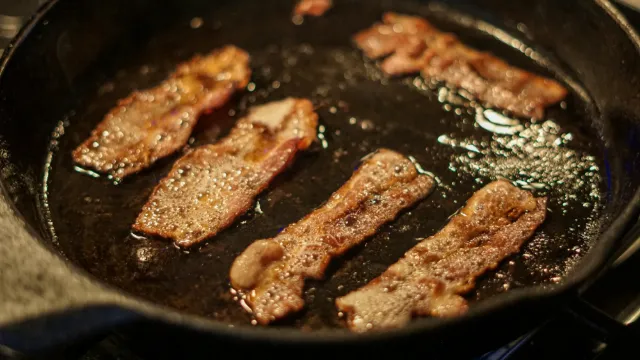
On the stove, every time you cook. Each time you cook with oil or fat, you add another layer. The fastest way to build a good surface on a new or freshly restored pan is to cook fatty things in it for the first few weeks: bacon, smash burgers, pan-fried potatoes, skillet cornbread. If the cornbread recipe wants buttermilk and you're out, a buttermilk substitute works fine. Lodge's fix for a dull pan is to sauté some vegetables.
If your skillet recipes live in a dozen bookmarks, import them into Hedgehog Chef and you get the recipe without the ads and pop-ups, with the source credited, and cook mode turns "bake 20 minutes" in the steps into a timer you can tap. For the rest of the collection, see how to organize recipes in one place.
How to clean cast iron after cooking
- Wash it while it's still warm, with warm water, a drop of dish soap and a stiff brush or scrubbing pad. Lodge says soap is totally okay, because today's dish soap isn't strong enough to remove seasoning.
- For stuck-on food, use a nylon brush or a pan scraper. Coarse salt makes a decent abrasive.
- Dry it with a towel right away, then over medium-low heat until the last of the moisture is gone.
- Rub in a thin film of oil with a paper towel. ATK's rule is half a teaspoon for a 12-inch skillet, max. The pan should never look glossy.
Never soak it and never put it in the dishwasher. Lodge says soaking is a recipe for rust and the dishwasher will strip the seasoning. Metal spatulas, on the other hand, are fine: Lodge welcomes any utensil.
Can you cook tomato sauce in cast iron?
Yes, for short cooks in a well-seasoned pan. ATK simmered tomato sauce in seasoned and unseasoned cast iron. After 15 minutes, tasters couldn't detect a metallic flavor in any of them. At 30 minutes they could, in both cast iron pans, with far more in the sauce from the unseasoned one. Acid also wears the seasoning down, and Lodge says large amounts of very acidic food cooked for a long time can break it down.
So a pan sauce deglazed with wine, a squeeze of lemon over fish or a tomato sauce that's done in 15 minutes is fine. For a three-hour ragù, use a stainless or enameled pot. ATK's other tips: add the acid late, and get the food out of the pan as soon as it's cooked. If it's a chicken braise, check how long cooked chicken lasts once it's in the fridge.
Enameled cast iron needs none of this. Lodge says none of its enameled pieces need seasoning, even those with a black interior, and ATK notes the enamel doesn't react with acid.
How to fix sticky, rusty or flaking cast iron
| Problem | What causes it | Fix |
|---|---|---|
| Sticky or gummy surface | Too much oil left on the pan | Bake upside down at 450–500°F (230–260°C) for 1 hour |
| Rust spots | Soaking, the dishwasher, air drying or damp storage | Scour with steel wool, wash, dry, oil, bake for 1 hour |
| Black flakes | Carbonized bits of oil coming loose | Scrub, dry, thin oil. Reseason if it keeps happening |
| Dull or patchy gray | Seasoning worn thin | Cook with fat, or one round in the oven |
| Brown spots on a new pan | Factory oil not fully carbonized (Lodge says it's safe, and it isn't rust) | Nothing. Cook with it |
Sticky or gummy
Lodge's troubleshooting page calls it a sign of excess oil built up on the pan. That oil never fully polymerized, so it stays tacky. Bake the pan upside down on the top rack at 450 to 500°F for an hour. If it's still tacky after that, or the gunk is thick, scrub it off with hot soapy water and a scouring pad, dry it on the stove and reseason with much thinner coats.
Rust
A rusty pan isn't ruined. For a few spots, wash, dry and oil it, and that may be enough. For more, Lodge's restoring steps are to scour the rusty sections with steel wool, wash with warm soapy water, dry completely, oil thinly and bake at 450 to 500°F for 1 hour. Repeat until the pan has a slight sheen.
Black flakes
Lodge says they're carbonized bits of oil and aren't harmful to you or the pan. Scrub with a nylon brush or salt, rinse, dry by hand and rub with oil. If it keeps flaking, give the pan a round in the oven.
Questions people ask
Do you season the outside of a cast iron pan too?
Yes. Lodge's method puts a thin layer of oil on the inside and the outside, and bare iron on the outside rusts as readily as the cooking surface. Oil the handle too, then bake the pan upside down so nothing pools.
Can you use olive oil to season cast iron?
Cook with it all you like, but don't use extra virgin olive oil for an oven seasoning. America's Test Kitchen says it can burn before it polymerizes. Canola or vegetable oil costs less and is what Lodge's test kitchen uses.
Do you need to season a new cast iron skillet?
Not if it's sold as pre-seasoned, as Lodge pans are. Lodge sprays a thin layer of vegetable oil on at the foundry and bakes it at a high temperature. Wash it, dry it, oil it lightly and cook something fatty in it first.
What happens if you put cast iron in the dishwasher?
Lodge says the dishwasher will remove the seasoning and likely cause rust. If it's already happened, scour off any rust with steel wool, wash and dry the pan, then reseason it in the oven at 450 to 500°F (230 to 260°C) for an hour.
Why does my cast iron pan smell after cooking fish?
Now and then a strong smell lingers. Lodge's fixes start with a good wash in warm soapy water. If the smell stays, cover the cooking surface with table salt overnight and rinse it off, or bake the pan at 400°F (205°C) for 15 minutes.
Sources, checked on October 14, 2026:
- Lodge Cast Iron: How to Season
- Lodge Cast Iron: How to Clean
- Lodge Cast Iron: How to Fix Common Cast Iron Concerns
- Lodge Cast Iron: How to Restore and Season a Rusty Cast Iron Skillet
- Lodge Cast Iron: What oils should you use for cast iron cooking and seasoning?
- Lodge Cast Iron: 10 Myths About Cast Iron Cookware
- Lodge Cast Iron: Cleaning & Care, Enameled Cast Iron
- America's Test Kitchen: The Science of Seasoning
- America's Test Kitchen: How to Clean and Season a Cast-Iron Pan
- America's Test Kitchen: What I Know About Cleaning and Seasoning Cast-Iron Skillets
- America's Test Kitchen: Can You Cook Acidic Ingredients in Cast-Iron Skillets?
- Mississippi State University Extension: How to Care for Cast Iron
Lodge and America's Test Kitchen are trademarks of their owners. Hedgehog Chef isn't affiliated with or endorsed by them.
Spotted something out of date or wrong? Tell us at hello@hedgehogchef.com and we'll fix it.