Can you make stuffing ahead of time?
Thanksgiving has one oven and four dishes that want it at 3 o'clock, and stuffing is the easiest one to move. It can be done days early. What you can't do is the thing most people try first: mix it Wednesday night, cover the dish and leave it in the fridge until Thursday morning.
By Hedgehog Chef · · 8-minute read
The quick answer
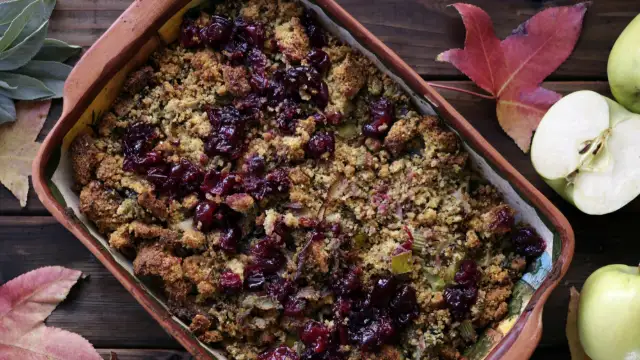
Yes. Bake the stuffing completely, chill it within 2 hours and reheat it to 165°F (74°C) on the day. It keeps 3 to 4 days in the fridge. Or mix it and freeze it unbaked right away, then bake it from frozen. The USDA says never to refrigerate uncooked stuffing that's already mixed.
- Dry the bread and cook the onions, celery and any sausage days ahead, and keep the dry and wet parts in separate containers.
- Combine them only when the dish is going straight into the oven or straight into the freezer.
- Baked stuffing: shallow container, into the fridge within 2 hours, eaten within 3 to 4 days.
- Reheat covered, with a splash of broth, until the center reads 165°F on a thermometer.
- Bake it in its own dish if you're cooking ahead. Stuffing never goes into the bird the night before.
Can you make stuffing ahead of time?
Yes, three ways, and they differ by how much of the work they move off the day. The USDA's guidance on stuffing and food safety allows all three. What it rules out is the halfway version: raw, mixed stuffing sitting in the fridge waiting to be baked.
| Method | How far ahead | On the day |
|---|---|---|
| Prep the parts: dry bread, cooked vegetables and meat, kept separate | Bread: a week or more. Cooked parts: up to 3 to 4 days | Mix, bake about as long as the recipe says |
| Bake it completely, then chill | Up to 3 to 4 days | Reheat to 165°F (74°C) |
| Mix it and freeze it unbaked | Weeks | Bake from frozen, no thawing, to 165°F |
| Mix it and refrigerate it unbaked | Not recommended by the USDA | Bake it or freeze it instead |
For most people the second one is the right call. Bake it on Tuesday or Wednesday, when the oven is free, and on Thursday it only needs reheating, which can share the oven with something else. Prepping the parts saves the chopping but still needs the full bake on the day. Freezing it raw suits a big batch you want finished in early November.
Why can't you refrigerate unbaked stuffing overnight?
Because mixed, uncooked stuffing is moist bread with broth, butter, often egg and sometimes meat juices through it, and that's an excellent place for bacteria to grow. The cold of a fridge slows them down without stopping them. An FSIS tip sheet, reprinted by University of Wisconsin Extension, puts it in one line: “USDA recommends that you never refrigerate uncooked stuffing.”
Then there's the bake. A dish straight from the fridge starts at 40°F in the center, and a deep pan of dense, wet bread heats slowly, so the middle spends a long time in the 40°F to 140°F (4°C to 60°C) danger zone before it gets hot enough to kill anything.
Plenty of published recipes tell you to assemble the dish and refrigerate it overnight. The USDA's advice is stricter, and it's the one we follow. If you want it assembled before Thursday, either bake it or freeze it.
Keeping the parts separate is allowed. The FSIS stuffing basics say the dry and wet ingredients can be prepared ahead and chilled separately, as long as they're combined only when the stuffing is about to be cooked.
How to bake, chill and reheat stuffing
Bake it the way the recipe says, to 165°F (74°C) in the center, checked with an instant-read thermometer. Then:
- Cool it fast. Hot food can go straight into the fridge, according to the USDA's leftovers guidance. A deep 9-by-13 pan holds heat in the middle for a long time, so spoon a full pan into two or three shallow containers. It has to be in the fridge within 2 hours of coming out of the oven.
- Cover it once it's cold. Covering it hot traps steam, which drips back and makes the top soggy.
- Reheat it on the day. Put it back in a baking dish, sprinkle a few spoonfuls of broth over it, cover with foil and heat at 350°F (175°C) until the center reaches 165°F. Take the foil off near the end to brown the top.
Short of oven space? Microwave it in portions, covered and stirred halfway, and check more than one spot, since microwaves leave cold patches.
Once it's hot, keep it at 140°F (60°C) or above until serving, or get it back into the fridge within 2 hours. The 3 to 4 days count from the day you first baked it, not from Thanksgiving, so stuffing baked on Tuesday has to be eaten or frozen by Friday.
Food safety: Don't put stuffing you cooked ahead into the turkey to finish there. The FSIS tip sheet says not to stuff any whole bird with cooked stuffing. Reheat it in its own dish.
Can you freeze stuffing, baked or unbaked?
Both work. Freezing is the only safe way to hold stuffing that's been mixed but not cooked.
Freezing it unbaked
The FSIS tip sheet gives three conditions: combine the ingredients, put them in a shallow container, and freeze immediately. Don't mix it in the morning and freeze it at night. When you're ready, bake it from frozen without thawing, until the center reaches 165°F. That takes noticeably longer than the recipe's time, so start it early and go by the thermometer. Freeze it in a pan that's made to go from freezer to oven, such as a disposable aluminum one, or check your dish's instructions before it goes in cold.
Freezing it baked
Cool it as above, then freeze it in portions or in the pan, wrapped tightly. The USDA's leftovers page gives 3 to 4 months in the freezer for cooked leftovers. Food kept at 0°F (−18°C) stays safe indefinitely, according to the USDA's freezing guide, so that limit is about texture: the bread dries out and picks up freezer smells the longer it sits. Reheat it from frozen or after a night in the fridge, to 165°F either way, with extra broth.
Label the pan with the date and whether it's baked. Under foil the two look alike, and they need different oven times.
What can you prep ahead without mixing it?
Most of the work, which is why prepping the parts is worth doing even if you'll mix and bake on Thursday.
- The bread. Cube it and dry it in the oven. In a side-by-side test by Cook's Country, bread left out to go stale made a wet, pasty stuffing, because staling locks the bread's moisture inside crystallized starch. It only feels dry. Oven-dried cubes have lost the water and soak up broth without falling apart. Once they're dry through and cool, bag them airtight at room temperature, or freeze them if you're working weeks out.
- The vegetables. Cook the onions, celery and herbs in butter, cool them and refrigerate them in their own container. Treat them like any cooked leftover: 3 to 4 days.
- Meat and seafood. The FSIS says to cook any raw meat, poultry or shellfish before it goes into stuffing. Brown the sausage ahead, drain it and chill it with the vegetables or on its own.
- The liquid. Measure the broth into a jar and keep it in the fridge. Add the eggs on the day, when everything is mixed.
On Thursday, warm the broth with the vegetables, pour it over the bread, add the eggs, mix and bake. If you're making a double batch for a big table, the free recipe scaler scales the whole ingredient list at once, and how much turkey per person covers how much stuffing to plan for each guest.
What if you stuff the turkey?
Then nothing gets mixed ahead. You can still dry the bread and cook the vegetables in advance, but the wet and dry parts are combined just before they go into the bird, and the bird goes straight into an oven set no lower than 325°F (165°C), per the FSIS tip sheet. Stuff it loosely, about ¾ cup per pound of turkey, and the stuffing in the center of the cavity has to reach 165°F, even if that means leaving the turkey in after the meat is done.
That's why the USDA and the UC Master Food Preserver Program recommend baking stuffing in a separate dish. The meat can reach temperature while the stuffing inside it hasn't, and a separate dish is the one you can make ahead. The turkey cooks faster empty, too.
When to make stuffing in Thanksgiving week
A schedule that works for a Thursday dinner: dry the bread the weekend before. Cook the vegetables and sausage on Monday or Tuesday. Mix and bake on Tuesday or Wednesday, chill it, and reheat it on Thursday while the turkey rests, which the FSIS tip sheet puts at 20 minutes before serving. The Thanksgiving cooking timeline fits it around the rest of the menu, including the mashed potatoes you can also make ahead.
Writing the steps onto the days is what keeps them from colliding. In Hedgehog Chef's meal planner, put the stuffing recipe on Wednesday, with a reminder of your own (“Remind me Tuesday at 7 to dry the bread”). On Thursday, Cook a meal times up to six recipes to finish together for the ovens and burners you have, so the reheat starts when it should.
Questions people ask
How long does leftover stuffing last in the fridge?
3 to 4 days, counted from the day it was first baked, if it went into the fridge within 2 hours. Freeze it before then if you won't finish it. Reheat it to 165°F (74°C) before eating.
Is dressing the same as stuffing?
For food safety, yes. The USDA notes that the same dish is called stuffing, filling or dressing depending on the region, and some families use dressing for the version baked outside the bird. The make-ahead rules are the same whatever it's called.
Can you make boxed stuffing mix ahead of time?
Yes, the same ways. The dry crumbs keep in the pantry. Once you've added the water or broth and butter it's mixed stuffing, so cook it and chill it, or freeze it right away, rather than leaving it in the fridge to bake later.
How long can stuffing sit out on the table?
No more than 2 hours, or 1 hour if the room is above 90°F (32°C). After that it goes in the bin, not the fridge. Put leftovers away as soon as the meal is over and take seconds from a dish kept in a warm oven.
Can you reheat stuffing more than once?
You can, if it goes back in the fridge promptly each time and reaches 165°F (74°C) every time it's reheated. Each round dries it out, so reheat only what you'll eat and add a little broth.
Sources, checked on October 17, 2026:
- USDA FSIS: Stuffing and Food Safety
- USDA FSIS: Turkey Basics, Stuffing
- USDA FSIS tip sheet, via University of Wisconsin Extension: Tips to Handle Stuffing With Care
- USDA FSIS: Leftovers and Food Safety
- USDA FSIS: “Danger Zone” (40°F–140°F)
- USDA FSIS: Freezing and Food Safety
- UC Master Food Preserver Program: Stuffing, In or Out?
- Cook's Country: Oven-dried vs. stale bread for stuffing
Spotted something out of date or wrong? Tell us at hello@hedgehogchef.com and we'll fix it.