Can you cook a partially frozen turkey?
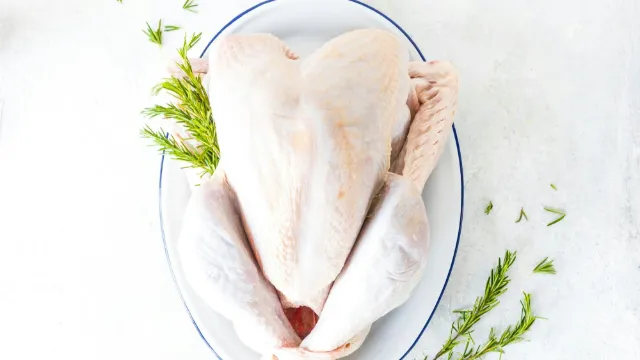
It's Thanksgiving morning, the turkey has had three days in the fridge, and your hand meets ice when you reach into the cavity. You don't need to cancel dinner or run it under the hot tap. A frozen or half-frozen bird roasts safely in the oven. It takes longer, and you have to check it in more places.
By Hedgehog Chef · · 8-minute read
The quick answer
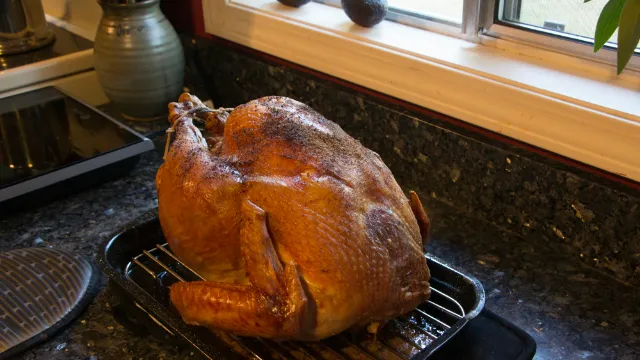
Yes, you can cook a partially frozen turkey in the oven. Roast it at 325°F (165°C) or higher and allow extra time: a solidly frozen turkey takes at least 50% longer than a thawed one, a half-thawed one somewhere in between. It's done when a thermometer reads 165°F (74°C) in the thigh, the wing and the thickest part of the breast.
- Roast it in the oven. A bird with ice in it never goes in a deep fryer.
- Pull the giblet bag out with tongs as soon as the cavity has thawed enough, usually 2 to 3 hours in.
- Cook the stuffing in a separate dish.
- If you have a few hours, finishing the thaw in cold water (30 minutes per pound) shortens the roast.
- Never leave it on the counter to finish thawing.
How much longer does a partially frozen turkey take?
For a turkey frozen solid, the USDA's rule is at least 50% longer than the time for a fully thawed one, from its consumer guide Let's Talk Turkey. Nobody publishes a figure for a partly frozen bird, because “partly” covers everything from a few ice crystals to a block with soft drumsticks. Plan for somewhere between the two columns below, and closer to the right-hand one the more ice you found.
| Turkey weight | Thawed (USDA timetable) | Frozen solid (at least) |
|---|---|---|
| 8 to 12 lb (3.6 to 5.4 kg) | 2¾ to 3 hours | 4 h 10 min to 4 h 30 min |
| 12 to 14 lb (5.4 to 6.4 kg) | 3 to 3¾ hours | 4 h 30 min to 5 h 40 min |
| 14 to 18 lb (6.4 to 8.2 kg) | 3¾ to 4¼ hours | 5 h 40 min to 6 h 25 min |
| 18 to 20 lb (8.2 to 9.1 kg) | 4¼ to 4½ hours | 6 h 25 min to 6 h 45 min |
| 20 to 24 lb (9.1 to 10.9 kg) | 4½ to 5 hours | 6 h 45 min to 7 h 30 min |
The middle column is the USDA's roasting timetable for an unstuffed bird at 325°F. The right-hand column is that time multiplied by 1.5 and rounded up to the next 5 minutes. Treat both as the time to start checking. The thermometer decides when it comes out.
On a fixed dinner time, the extra 1½ to 2½ hours means starting the bird earlier or pushing dinner back. Tell people now.
How to tell how frozen the turkey still is
Reach into the main cavity. Ice, or a giblet bag that won't come loose, means the deepest part is still frozen, and that part cooks last. Then press the thickest part of the thigh. Firm and cold is thawed. Rock hard is frozen.
A few ice crystals in an otherwise soft bird land near the thawed column. A frozen cavity and stiff thighs mean plan with the right-hand column.
The thigh joint matters most. Dark meat takes longer to cook than any other part of the turkey, as University of Wyoming Extension notes, and a frozen core sits right next to it. If the breast reaches 165°F well before the thigh, cover the breast loosely with foil (the USDA's own fix for over-browning) and keep roasting.
Getting the giblets out of a frozen turkey
Put the turkey in the oven with the giblets inside, and take them out once the cavity has thawed enough to let go of them. For a fully frozen bird, Wyoming's extension guide puts that at about 3 hours. A partly thawed one gets there sooner, so check after an hour or two. The USDA's guide says to remove them carefully with tongs or a fork, since the bag and the cavity will be hot.
Many turkeys have two packages: the neck in the main cavity and a bag of heart, liver and gizzard in the neck cavity under the flap of skin at the front. Look in both places. Cook the giblets separately, in a small pan of water, for gravy or stock.
What if the bag stays in the whole time? It depends on the wrapping. According to the USDA's page on hock locks and giblet bags, a paper-wrapped package that cooked inside the bird to a safe temperature is no concern. A plastic bag that came out intact is also fine once the meat is fully cooked. If the plastic bag melted or changed shape, throw out both the giblets and the turkey, because chemicals from the plastic may have moved into the meat.
While the tongs are out, brush the skin with oil or butter and season it. Salt won't stick to icy skin.
Should you finish thawing it in cold water first?
If you have 2 hours or more before it needs to go in the oven, yes. The cold-water method in the USDA's thawing guide runs about 30 minutes per pound for a fully frozen bird, so a partly thawed one needs a fraction of that. Keep the turkey in its wrapper (or a sealed bag if it's torn), submerge it in cold tap water and change the water every 30 minutes. Cook it as soon as the cavity is free of ice.
Never use warm water or the counter. The USDA's thawing guide says that while the center of a frozen package is still frozen on the counter, the outer layer can be in the “danger zone” between 40°F and 140°F (4°C and 60°C). Nothing perishable should be left at room temperature for more than 2 hours.
Food safety: A turkey thawed in cold water has to be cooked right away and shouldn't be refrozen raw. A turkey that thawed in the fridge can wait there 1 to 2 more days (how long a thawed turkey keeps in the fridge).
Checking the temperature in three places
The USDA says a whole turkey is safe at 165°F (74°C), measured in the innermost part of the thigh, the innermost part of the wing and the thickest part of the breast. On a frozen bird all three matter, because the parts thaw at different rates and the thigh near the frozen center is usually last.
- Thigh first. Push the probe into the thickest part of the inner thigh, close to the body, without touching the bone (bone reads hot).
- Then the wing, in its innermost part, close to the body.
- Then the breast, sideways into its thickest part, from the neck end.
If any of the three reads under 165°F, it goes back in for 15 to 20 minutes, and you check that spot again. The USDA's guide suggests leaving an oven-safe probe in the thigh from the start. A pop-up timer, if the bird has one, isn't enough on its own. Check with a thermometer as well.
Some meat near the bones can stay pink after it's reached 165°F. Wyoming's extension guide says all turkey meat, pink or not, is safe once every part reaches 165°F. Let the bird stand 20 minutes before carving, so the juices set and it carves more easily.
Can you cook a turkey that's still fully frozen?
Yes, in the oven. The USDA says it's safe to cook a turkey from the frozen state, and the method is the same as for a partly frozen one, only longer.
- Heat the oven to 325°F (165°C). The USDA says to set it no lower than that.
- Unwrap the bird and set it breast-side up on a rack in a shallow roasting pan.
- Roast for about 3 hours, then pull out the neck and giblets with tongs, oil and season the skin, and put a thermometer probe in the thigh.
- Keep roasting, using the right-hand column of the table as a guide. Tent the breast with foil if it browns too fast.
- Check 165°F in the thigh, wing and breast, then rest it 20 minutes.
Don't stuff it. A frozen cavity can't be filled anyway, and the USDA recommends cooking stuffing in a casserole dish even for a thawed bird (here's how far ahead you can make it).
Don't put it in a fryer either. University of Wisconsin-Madison Extension says a turkey for deep-frying should be completely thawed. Ice hitting 350°F oil turns to steam at once and can push the oil over the rim of the pot, onto the burner.
Moving the rest of dinner around a late turkey
Only the turkey's time has grown. Key everything else to its new finish time: the 20-minute rest frees the oven for rolls and the stuffing, and the giblets go into the gravy while the bird finishes.
In Hedgehog Chef, Cook a meal takes the recipes for dinner and a serve time, then schedules every step backwards from it, so moving the serve time back an hour moves the sides with it. The Thanksgiving cooking timeline lays out the whole week.
The easiest fix for next year is a reminder on the right day. A 16-pound turkey needs about 4 days in the fridge (24 hours per 4 to 5 pounds, says the USDA, with the full table in thawing a turkey in the fridge), so it has to leave the freezer on the Sunday before Thanksgiving. In the meal planner you can set your own reminder, such as “move the turkey to the fridge” on that Sunday morning.
Questions people ask
Is it safe to cook a turkey that's still frozen in the middle?
Yes, in the oven at 325°F or higher. The USDA says a turkey can be cooked from frozen and will take at least 50% longer than a thawed one. It's safe when the thigh, wing and thickest part of the breast all reach 165°F.
Can you deep-fry a partially frozen turkey?
No. A turkey for the fryer should be completely thawed. Ice in the cavity turns to steam in 350°F oil and can make the pot boil over onto the flame.
Can I leave a partially frozen turkey on the counter overnight to finish thawing?
No. The USDA's thawing guidance says perishable food must not sit at room temperature more than 2 hours, and the outside of a thawing bird can be in the danger zone while the middle is still frozen. Use the fridge, or cold water changed every 30 minutes.
Can you refreeze a partially thawed turkey?
Yes, if it thawed in the fridge and stayed at 40°F or below, though the meat may lose some quality. A turkey thawed in cold water or in the microwave shouldn't be refrozen raw. Cook it first.
Should I raise the oven temperature to cook a frozen turkey faster?
The USDA's times assume 325°F, its minimum. A hotter oven browns the outside long before a frozen center catches up. Start earlier instead, and tent the breast with foil if it darkens too fast.
Sources, checked on October 18, 2026:
- USDA FSIS: Let's Talk Turkey, a consumer guide to safely roasting a turkey
- USDA FSIS: Let's Talk Turkey (printable guide with roasting timetables)
- USDA FSIS: The Big Thaw, Safe Defrosting Methods
- USDA FSIS: Hock Locks and Other Accoutrements (giblet bags)
- University of Wyoming Extension: Let's Talk Turkey
- University of Wisconsin-Madison Extension: Turkey frying safety
Spotted something out of date or wrong? Tell us at hello@hedgehogchef.com and we'll fix it.