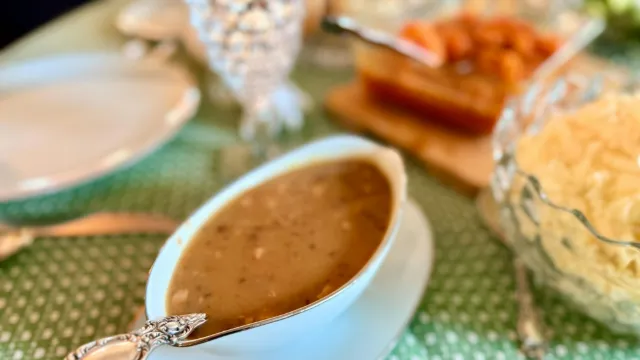
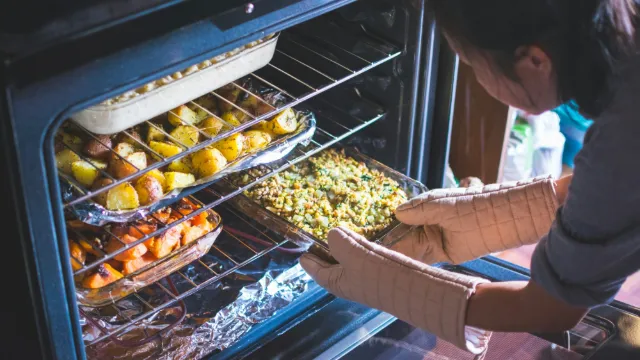
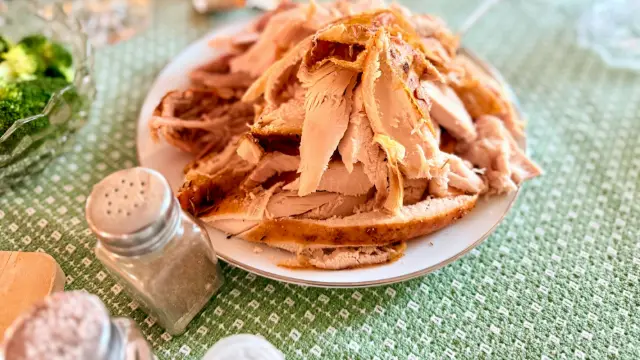
How to make gravy without drippings
Drippings arrive in the last half hour before dinner, while the turkey rests and every burner is spoken for. Gravy made from butter, flour and a good stock can be finished days earlier, and it tastes like roast bird if the stock does.
By Hedgehog Chef · · 8-minute read
The quick answer
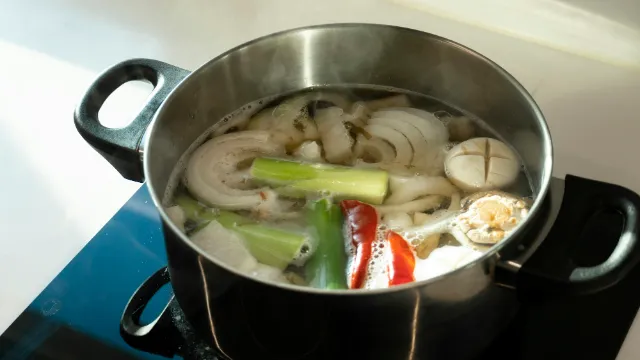
To make gravy without drippings, melt 2 tablespoons of butter, whisk in 2 tablespoons of flour and cook it for 2 minutes, then whisk in 1 cup of hot stock and simmer about 5 minutes until it coats a spoon. Use the best-tasting stock you can get, ideally one made from roasted turkey wings, because the stock is where the flavor comes from.
- 2 tablespoons each of fat and flour per cup of stock gives a gravy that pours but clings. Scale it up by the cup.
- Roasting wings until dark brown and simmering them for 2 hours gives you stock that tastes like the roast.
- Finished gravy keeps 1 to 2 days in the fridge and 2 to 3 months in the freezer (FDA).
- Reheat it to a rolling boil, and whisk in any drippings you do get on the day.
How do you make gravy without drippings?
Make a roux, then thin it with hot stock. Drippings bring fat and browned flavor to a gravy. Here butter (or skimmed poultry fat) stands in for the fat and a dark stock for the flavor. The steps below follow University of Wyoming Extension's gravy method, for 2 cups of gravy.
- Heat 2 cups of stock in a small pot until it steams.
- Melt 4 tablespoons of butter in a saucepan over medium-low heat.
- Whisk in 4 tablespoons (¼ cup) of all-purpose flour and keep stirring for 1 to 2 minutes, until it smells toasty and turns the color of light peanut butter. Don't let it scorch.
- Pour in about ½ cup of the hot stock and whisk until it's a smooth, thick paste.
- Add the rest of the stock a little at a time, whisking the whole time.
- Bring it to a simmer and cook about 5 minutes, whisking now and then, until it coats the back of a spoon. Season with pepper, and taste before adding salt, because the stock already has some.
Cooking the flour in fat first coats each grain of starch, so it spreads through the stock instead of clumping, and those 2 minutes take away the raw-flour taste. If it does go lumpy, or comes out thin, our post on fixing lumpy gravy has the rescues.
How much flour and butter per cup of stock?
For a gravy that pours and still clings to turkey, use 2 tablespoons of fat and 2 tablespoons of flour per cup of stock. One tablespoon of each makes a thin, jus-like gravy. Wyoming Extension's classic “3-2-1” (3 tablespoons flour, 2 tablespoons fat, 1 cup liquid) is thicker again, closer to what goes over biscuits.
| Gravy you need | Butter or fat | All-purpose flour | Hot stock |
|---|---|---|---|
| 1 cup (2 people) | 2 tablespoons | 2 tablespoons | 1 cup (240 ml) |
| 2 cups (4 people) | ¼ cup | ¼ cup | 2 cups (475 ml) |
| 4 cups (8 people) | ½ cup (1 stick) | ½ cup | 1 quart (950 ml) |
| 8 cups (16 people) | 1 cup (2 sticks) | 1 cup | 2 quarts (1.9 liters) |
Plan on about ½ cup a person, which leaves some for hot turkey sandwiches the next day. For the rest of the meal's quantities, see how much turkey per person. To turn a family recipe for 1 cup into one for 12 people, paste its ingredient list into the free recipe scaler, which keeps the measures readable (8 tablespoons doubled comes back as 1 cup).
Cornstarch works if you need the gravy gluten-free. It has about twice the thickening power of flour, so use about 1 tablespoon per cup of stock, stirred into 1 to 2 tablespoons of cold water first and whisked into the simmering stock. It sets glossier and thinner-feeling than a roux, and it freezes worse (see below).
How to make turkey gravy ahead with roasted wings
Roast turkey wings until they're deep brown, then simmer them into stock. That gives you your own drippings weeks early, and wings have enough skin and joints to make a stock with body: chilled, it sets like loose jelly.
- Heat the oven to 425°F (220°C). Spread 3 to 4 pounds (1.4 to 1.8 kg) of turkey wings, or wings and necks, in a roasting pan with a quartered onion, 2 carrots and 2 celery ribs in chunks.
- Roast about 1 hour, turning once, until the skin is dark brown and the pan has a brown crust.
- Move everything to a stockpot. Pour 2 cups of water into the hot roasting pan and scrape up the brown bits: that crust is the flavor a roast would have left you. Add it to the pot.
- Cover with about 3 more quarts of water, add a bay leaf and a few peppercorns, and bring to a boil, then turn it down to a bare simmer for 2 hours, skimming foam now and then. That's the simmer University of Illinois Extension uses for its turkey bone broth.
- Strain it, then boil the strained stock until about 2 quarts are left. Reducing concentrates the flavor.
Cool it quickly. The USDA's leftovers guidance wants it in the fridge within 2 hours, divided into shallow containers so the middle cools fast. Overnight, the fat rises and hardens on top. Lift it off and use it as the fat in your roux instead of butter, and you've rebuilt a drippings gravy from scratch. Two quarts of stock makes 8 cups of gravy at the ratio above.
Buy the wings when you plan the menu, before the holiday rush. Hedgehog Chef's shopping list sorts them into their aisle with everything else on the menu, and the Thanksgiving grocery list covers what else to buy that week.
Tip: No time for wings? Simmer unsalted or low-sodium store-bought stock for 20 minutes with a browned onion and some thyme. Avoid full-salt stock if you plan to reduce it, because boiling off water leaves all the salt behind.
How to get roast flavor into gravy without drippings
Brown something. Store-bought stock tastes flat next to drippings because nothing in it was browned. Two or three of these together close most of the gap:
- Cook a finely chopped shallot or half an onion in the butter until golden before you add the flour. Sliced mushrooms browned the same way add more.
- Take the roux further, to the color of milk chocolate, over low heat with constant stirring. It tastes nuttier. Add a spoonful more flour if it seems to thicken less.
- Add a teaspoon of soy sauce or Worcestershire sauce per 2 cups of gravy. At that amount they add savory depth without tasting of themselves.
- Simmer a sprig of sage or thyme in it, and finish with a splash of dry sherry or cider vinegar to lift a heavy gravy.
Season last. Gravy reduces as it simmers and again as it's reheated, so salt added early can end up too much.
Can you make gravy ahead and freeze it?
Yes. The FDA's storage chart gives gravy and meat broth 1 to 2 days in the fridge and 2 to 3 months in the freezer at 0°F (−18°C). The same times apply to the wing stock, so anything made more than two days before the dinner goes in the freezer.
Freeze the stock and make the gravy on the day if you can. University of Georgia Extension's holiday freezing advice says the same, because gravy tends to separate when it thaws, and the roux takes 10 minutes with thawed stock. Frozen stock in flat quart bags thaws overnight in the fridge.
Finished flour gravy freezes well enough. Ohio State University Extension's fact sheet on freezing combination dishes notes that flour-thickened gravies can look curdled once thawed but usually come back together when stirred, and that cornstarch may be less successful. Whisk it as it heats and it smooths out. Leave out milk or cream until reheating, since dairy sauces are the ones most likely to separate.
Make-ahead gravy sets nearly solid in the fridge from the gelatin in the stock. That's normal. Warm it over medium-low heat, whisking, add a splash of stock if it's too thick, and bring it to a rolling boil, which is how the USDA says to reheat gravies and sauces.
Food safety: Cool gravy and stock in shallow containers and get them into the fridge within 2 hours of cooking. Gravy left out longer than that, for example on the table through a long dinner, goes in the bin.
What to do with the drippings on the day
Add them. If you roast a turkey and get drippings after all, pour them into a measuring cup, let the fat rise for a few minutes, spoon it off, and whisk the dark juices underneath into the hot make-ahead gravy. Then bring the gravy back to the boil and taste for salt, since drippings from a brined bird can be very salty.
The Thanksgiving cooking timeline puts the gravy base two weeks out and the reheating in the last half hour. In the meal planner, put the wing stock on a weekend afternoon two weeks ahead and the gravy on the holiday itself. Shop for the week from the plan and the wings land on the list, and the “Thaw it tonight” reminder covers recipes with frozen ingredients the evening before.
Questions people ask
Can you make gravy with just water and flour?
You can, but it will taste only of butter and flour. Use stock or broth, even a bouillon cube dissolved in hot water, because the liquid supplies almost all the flavor.
Can I use oil instead of butter for gravy?
Yes. Any neutral oil makes a working roux in the same amounts, 2 tablespoons per cup of stock. Butter browns and tastes nuttier, so oil gravy needs a browned onion or a darker stock to make up for it.
How far ahead can you make turkey gravy?
One to two days ahead in the fridge, or 2 to 3 months ahead in the freezer, according to the FDA's storage chart. Thaw frozen gravy or stock in the fridge the night before.
Can you make gravy from chicken broth for turkey?
Yes. Thickened and seasoned with sage or thyme, chicken stock makes a gravy that suits turkey. Choose unsalted or low-sodium broth so you control the salt, and brown an onion in the butter first for depth.
Why did my make-ahead gravy turn to jelly in the fridge?
Gelatin from the bones and skin in the stock sets as it chills, and the starch firms up too. It melts back to gravy as soon as it's warm. Reheat it slowly while whisking, thin it with a little stock if needed, and bring it to a rolling boil before serving.
Sources, checked on October 20, 2026:
- University of Wyoming Extension: Great Gravy!
- University of Illinois Extension: Turkey bone broth
- FDA: Refrigerator & Freezer Storage Chart
- USDA FSIS: Leftovers and Food Safety
- Ohio State University Extension: Freezing combination main dishes (hosted by K-State Research and Extension)
- University of Georgia Extension: Freeze holiday dinner leftovers, 'planned-overs'
Spotted something out of date or wrong? Tell us at hello@hedgehogchef.com and we'll fix it.