How to tell if pumpkin pie is done
The bake time in a pumpkin pie recipe was worked out in someone else's oven, in someone else's pan. Pull the pie a few minutes early and the slices slump onto the plate. Leave it in a few minutes long and a crack opens across the top while it cools. The filling shows you when it's ready, through the wobble in the middle and the temperature at its center, and a pie that missed in either direction can usually still go on the table.
By Hedgehog Chef · · 9-minute read
The quick answer
Pumpkin pie is done when the outer 2 inches of filling look set and matte, and the center still wobbles in a circle about 4 inches across when you nudge the pan. On an instant-read thermometer, the center reads 170 to 175°F (77 to 79°C). It keeps cooking from its own heat and finishes setting as it cools.
- Start checking 10 minutes before the recipe's time is up.
- Liquid that ripples across the whole surface needs more time. A center that doesn't move at all is overbaked.
- A knife that comes out of the center completely clean usually means you've gone too far.
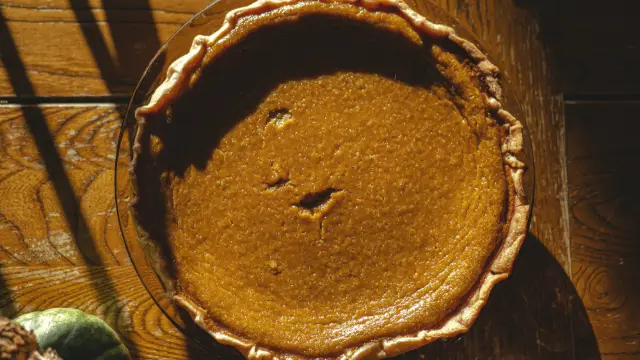
- Cracks come from overbaking and from cooling too fast. The pie is still fine to eat.
- Get it into the fridge within 2 hours of taking it out of the oven.
The jiggle test: how much should pumpkin pie jiggle?
About a 4-inch circle in the middle of a 9-inch pie, and no more. King Arthur Baking's guide to pumpkin pie doneness describes the moment to pull it: the filling is set about 2 inches in from the crust, matte instead of shiny, maybe slightly domed, and the center circle jiggles like set gelatin when the pan moves.
Open the oven, grip the pan's rim with a mitt and give it a short nudge. Watch how the center moves. If it wobbles as one soft piece, that's the stage you want. If waves run across the surface, it's still liquid underneath.
| What you see when you nudge the pan | What it means | What to do |
|---|---|---|
| Shiny all over, ripples spread to the edges | Underbaked | Close the oven and check again in 5 minutes |
| Edges matte and firm about 2 inches in, a 4-inch center that wobbles as one piece | Done | Take it out and cool it on a rack |
| Matte all over, center barely moves, edges puffed | Overbaked | Take it out now and expect a crack as it cools |
The center doesn't have to look finished, because the pie keeps cooking after it leaves the oven. King Arthur calls it carry-over cooking: residual heat sets the wobbly middle, and it's also why a pie that looks fully set in the oven goes too far on the rack.
The pan makes a small difference. King Arthur's post on cracked pumpkin pie says a stoneware or ceramic pie dish holds more heat, so the jiggly ring can be slightly bigger when you pull a pie baked in one.
What temperature is pumpkin pie done?
170 to 175°F (77 to 79°C) in the center. The sources that test this land close together. America's Test Kitchen bakes pumpkin pie until the center reads 175°F, while it still jiggles slightly. ThermoWorks, which makes thermometers, also pulls at 175°F. King Arthur aims lower, at 160 to 170°F, and warns that past 175°F you risk dry, overbaked edges and a center that cracks as it cools.
| Center temperature | What's happening | Source |
|---|---|---|
| 140 to 150°F (60 to 66°C) | Egg proteins start to firm | ThermoWorks |
| 160°F (71°C) | The safe minimum for egg dishes | FoodSafety.gov |
| 160 to 170°F (71 to 77°C) | King Arthur's target range | King Arthur Baking |
| 175°F (79°C) | America's Test Kitchen's and ThermoWorks' pull point | ATK, ThermoWorks |
| Above 175°F | Dry edges and a crack as it cools. The filling can curdle | King Arthur Baking, ThermoWorks |
Every one of those pull points clears the 160°F that FoodSafety.gov's temperature chart sets for egg dishes, so the choice between them is about texture. Aim for 170°F, the top of King Arthur's range, and have the pie out by 175°F, where the other two pull it.
Put the probe tip in the middle of the filling at the very center, which is the last part to set, without touching the crust. ThermoWorks says custards set somewhere between 160 and 180°F, and the more the eggs are diluted, the higher the number. Pumpkin pie is a well-diluted custard: ThermoWorks' recipe sets 15 ounces of pumpkin and 12 ounces of evaporated milk with 2 eggs.
One reading is enough. King Arthur points out that each hole you poke can encourage a crack, so use the thermometer for the first pie or two in a new oven, note the time it took, and go by the jiggle after that.
Is the knife test reliable for pumpkin pie?
Not on its own. Plenty of recipes say to bake until a knife inserted near the center comes out clean. ThermoWorks' view is that the blade only comes out clean once the pie is well on its way to overcooked, which is the stage that cracks and curdles. A knife also leaves a slit in the top, and King Arthur's point about holes applies to it too. Without a thermometer, go by the jiggle.
A store-bought frozen pie is the exception, because it's a different recipe made to be baked from frozen. Follow the box. Marie Callender's, for example, says its pumpkin pie is done when the outside edge of the filling is firm, the center is slightly domed and a knife in the center comes out clean.
Why pumpkin pie cracks, and how to stop it
Overbaking, almost every time. Eggs thicken the filling by setting, and the longer they cook the tighter they pull. King Arthur explains that the edge cooks faster than the middle, so it overcooks sooner, and cracks usually show up there first. The crack often opens after the pie is out of the oven, because carry-over heat keeps cooking it.
Fast cooling is the other cause. Krusteaz's guide to pie cracks says moving a pie from a hot oven into a much cooler room can make the filling contract too quickly, and that high heat sets the edges before the center catches up.
- Pull it at the jiggle stage, or by 175°F.
- Check your oven with a separate oven thermometer. King Arthur notes that most ovens say they're preheated well before they are, and that no recipe works in an oven running 50°F cooler than it should.
- Bake gently. ThermoWorks passes on America's Test Kitchen's method: 10 minutes at 400°F (200°C), then the rest of the bake at 300°F (150°C). In ThermoWorks' recipe, a 9-inch pie takes about 45 to 50 minutes at the lower temperature to reach 175°F.
- Bake it low in the oven. King Arthur puts the pie near the bottom so the crust browns underneath before the filling overcooks.
- Cool it slowly. Krusteaz's advice is to turn the oven off when the pie is done and leave it inside, with the door slightly open, for a few minutes before it comes out to cool.
A cracked pie is still good to eat. Expect drier edges, which King Arthur warns about above 175°F, and a filling that's less smooth than it should be (ThermoWorks says overbaked filling can curdle). King Arthur's fix for the look of it is a well-placed dollop of whipped cream.
How to fix an underbaked pumpkin pie
Put it back in the oven at the recipe's lower temperature and check every 5 minutes. King Arthur's advice is to start checking early because it's always easier to add time than to take it away, and a pie you pulled a few minutes too soon goes straight back in with no harm done.
A pie that's runny after it has cooled is a different problem. Give it a fair chance first: the center keeps firming as the pie cools, in the fridge as well as on the rack. If you cut it cold and the middle still runs, the eggs at the center never set, which means they probably never reached 160°F either.
That pie can still be saved, as long as it went into the fridge within 2 hours of baking, the USDA's limit for perishable food in the danger zone. Heat the oven to the recipe's lower temperature, cover the crust edge with a ring of foil so it doesn't burn on its second trip, and bake until the center reads at least 160°F, and ideally 170°F. There's no tested time for re-baking a cold pie, so go by the thermometer and check every 10 minutes.
Food safety: Pumpkin pie is made with eggs and milk. Once it's out of the oven, it has 2 hours at room temperature before it belongs in the fridge (1 hour above 90°F, 32°C). Our guide to whether pumpkin pie needs refrigerating covers how long it keeps after that.
The usual causes are an oven running cooler than its dial, a deeper pan than the recipe was written for, or pulling the pie at the recipe's earliest time without checking the center.
When to bake pumpkin pie for Thanksgiving
On Wednesday, November 25. Pumpkin pie keeps 3 to 4 days in the fridge after baking, so a Wednesday pie is fine on Thursday and still good on Saturday. The Thanksgiving cooking timeline puts the pies first on Wednesday's list, while the oven is free. Make the crust in early November and freeze it in the pan, as our pie crust post explains, and Wednesday's job is mixing the filling and watching the jiggle.
King Arthur cools its pies for several hours, but the USDA's 2-hour limit for perishable food applies to a pie made with eggs and milk. Cool it on a rack for about an hour, then refrigerate it, and it finishes setting overnight with an hour of the limit left for Thursday's table.
The numbers that matter are the ones from your oven. Save the pie recipe to Hedgehog Chef by importing it from the site it's on, and in cook mode a step that says “bake 45 to 50 minutes” becomes a timer you can start with a tap. Set your own check 10 minutes earlier. When it's out, log it with “I made this” and a note like “glass dish, 172°F at 48 minutes”, and next year's pie starts from that.
Questions people ask
How long does pumpkin pie take to bake?
King Arthur Baking's recipe bakes a 9-inch pie, at least 1½ inches deep, for 45 to 50 minutes at 400°F (200°C). ThermoWorks uses America's Test Kitchen's gentler method: 10 minutes at 400°F, then about 45 to 50 more at 300°F (150°C). Start checking 10 minutes early either way.
How long should pumpkin pie cool before you cut it?
King Arthur says the center keeps firming for several hours, so the longer the better. The USDA's 2-hour limit for perishable food applies, though, so cool it on the rack for an hour or two, then refrigerate it and slice it cold or the next day.
Is it safe to eat pumpkin pie with a soft center?
A soft, wobbly center that reached 170 to 175°F is the texture you want. A liquid center is different: the eggs there never set, so they probably never reached the 160°F that FoodSafety.gov gives for egg dishes. Bake it longer before serving it.
Does the pie pan change how much it should jiggle?
Yes, a little. King Arthur says a stoneware or ceramic dish holds more heat after it leaves the oven, so a slightly larger wobbly ring is fine in one. Its recipe bakes in a metal pan set on a baking stone or steel to keep the bottom crust from going soggy.
Sources, checked on November 2, 2026:
- King Arthur Baking: How to tell when pumpkin pie is done
- King Arthur Baking: How to keep pumpkin pie from cracking
- King Arthur Baking: Pumpkin pie recipe
- America's Test Kitchen: How to know when your pie is done
- ThermoWorks: The secrets to a silky smooth pumpkin pie
- Krusteaz: How to keep pies from cracking
- FoodSafety.gov: Safe minimum internal temperatures
- FoodSafety.gov: Cold Food Storage Chart
- USDA FSIS: “Danger Zone” (40°F–140°F)
- Marie Callender's: Frequently asked questions
King Arthur Baking, America's Test Kitchen, ThermoWorks, Krusteaz and Marie Callender's are trademarks of their owners. Hedgehog Chef isn't affiliated with or endorsed by them.
Spotted something out of date or wrong? Tell us at hello@hedgehogchef.com and we'll fix it.
More like this, once a month
One short email a month from Hedgehog Chef: what's new, one kitchen tip and one post like this. You can also ask to hear when the iPhone or Android app is out. Unsubscribe any time.