How to double or halve a recipe without mistakes
The recipe serves 4 and you're feeding 6, or it fills a 9 × 13 and there are two of you. The arithmetic takes a minute. The mistakes happen in the parts that don't follow it: the pan, the oven time, the salt, and the egg you can't split by eye.
By Hedgehog Chef · · 9-minute read
The quick answer
To scale a recipe, divide the servings you want by the servings it makes, and multiply every ingredient by that number: 6 servings from a recipe for 4 is × 1.5. Then fix what the arithmetic misses: pick a pan that keeps the food at the same depth, start checking for doneness early, add salt and spices a little under the math and taste, and measure half an egg as 2 tablespoons of beaten egg.
- Halve a 9 × 13 recipe into an 8-inch square or a 9-inch round pan.
- Cookies and muffins bake for the same time at any batch size, because each one is the same size.
- A deeper pan or a fuller pot takes longer. Check with a thermometer or a toothpick.
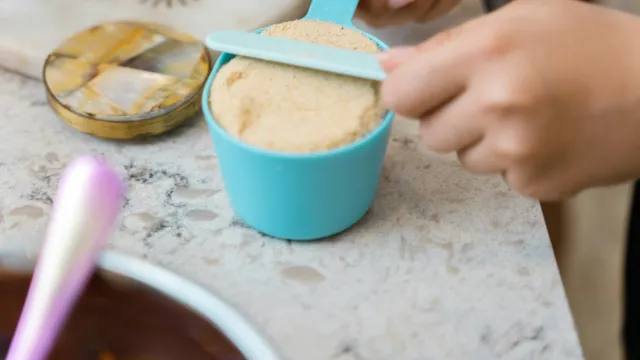
- Weigh what you can. 33 grams of sugar is easier to measure than half of ⅓ cup.
How to scale a recipe, step by step
Both K-State Research and Extension's fact sheet on reducing recipes and BCcampus's open textbook for food-service students start from one number, the conversion factor, and so does every recipe scaler.
- Find the factor. Servings you want ÷ servings the recipe makes. 8 from a recipe for 4 is 2. 2 from a recipe for 6 is ⅓. 10 from a recipe for 8 is 1.25.
- Multiply every ingredient by it. Write each new amount next to the old one, on paper or in the margin, before you take anything out of the cupboard.
- Round to something you can measure. 0.375 cup is 6 tablespoons. 1.5 eggs is one egg plus 2 tablespoons of a second, beaten.
- Change what isn't an ingredient. Pan size, cooking time and seasoning, each covered below.
For an awkward amount, convert to a smaller unit first. The free cooking converter turns cups into tablespoons or milliliters if your measuring set stops at ¼ cup.
| Measure | Half of it |
|---|---|
| 1 cup | ½ cup |
| ¾ cup | 6 tablespoons |
| ⅔ cup | ⅓ cup |
| ½ cup | ¼ cup |
| ⅓ cup | 2 tablespoons + 2 teaspoons |
| ¼ cup | 2 tablespoons |
| 1 tablespoon | 1½ teaspoons |
| 1 teaspoon | ½ teaspoon |
| ¾ teaspoon | ⅜ teaspoon (a scant ½ teaspoon) |
What doesn't scale in a straight line?
Flour, sugar, butter, liquid, meat and vegetables all multiply as written. Seasoning, leavening and anything you reduce on the stove need a decision from you, and eggs get their own section below.
Salt, spices and herbs
The BCcampus textbook tells cooks to increase spices and seasonings with caution when multiplying a recipe, because doubling or tripling them to match the factor can overshoot, and to under-season and adjust right before serving. K-State gives the same advice going the other way: when halving, use a little less than half and add more if it needs it. So hold some of the scaled salt, chili and strong spices back and taste at the end. You can add salt to a stew. You can't take it out.
Baking soda and baking powder
If you double a cake and bake it in two pans the same size as the original, you've made two batches in one bowl, and the leavening doubles with everything else. The trouble starts when the doubled batter goes into one bigger, deeper pan. That changes how the cake rises and how long it bakes, which is a pan problem, covered in the next section. Halving leavening is fine on paper, but ⅜ teaspoon is hard to measure, so use a ⅛ teaspoon three times.
Liquid that cooks down
A pot loses liquid from its surface. Double a soup in the same pot and it's twice as deep with the same surface, so a sauce that should reduce by half in 20 minutes will take longer. Use a wider pan, or give it more time and judge it by how thick it looks.
How do you halve an egg?
Crack it into a small bowl, beat it with a fork until the white and yolk are one color, and measure out 2 tablespoons. That's half. K-State puts a standard large egg, the size most recipes mean, at ¼ cup, and America's Test Kitchen measures it at about 4 tablespoons, a little under an ounce for the half. Each half portion of yolk or white alone is about 1 tablespoon.
The same trick covers any fraction:
- 3 eggs halved (1½ eggs): one whole egg, plus 2 tablespoons from a second, beaten.
- 3 eggs × 1.5 (4½ eggs): four whole eggs and 2 tablespoons of a fifth.
- 1 egg × ⅓: a little under 1½ tablespoons of beaten egg.
Cover the leftover egg, refrigerate it and use it within two days, K-State's limit. It's enough for an egg wash on a pie crust.
Should you convert to weight before scaling?
Yes, for baking, if you own a kitchen scale. The textbook's method is to express ingredients by weight before converting, and leave only the amounts too small to weigh, like spices, as spoons. Weight halves in one step: half of 66 grams is 33 grams, while half of ⅓ cup is 2 tablespoons plus 2 teaspoons, measured in two goes.
To get the weights, use a chart that matches how the recipe writer measured. King Arthur Baking's ingredient weight chart gives these per cup:
| Ingredient | 1 cup | ½ cup | ⅓ cup |
|---|---|---|---|
| All-purpose flour | 120 g | 60 g | 40 g |
| Granulated sugar | 198 g | 99 g | 66 g |
| Brown sugar, packed | 213 g | 107 g | 71 g |
| Butter | 227 g (16 tablespoons) | 113 g | 76 g |
| Milk or water | 227 g | 113 g | 76 g |
If a recipe gives grams, scale the grams and ignore the cups.
What size pan for a doubled or halved recipe?
One whose floor area changes by the same factor as the recipe, so the food sits at the same depth, which is K-State's rule. Its example is that a 9 × 13 pan holds 14 to 15 cups, and half the recipe goes in an 8 × 8 square or a 9-inch round.
| Pan | Floor area | Fits |
|---|---|---|
| 8 × 8-inch square | 64 sq in | Half a 9 × 13 recipe |
| 9-inch round | 64 sq in | Half a 9 × 13 recipe. Same area as the 8-inch square |
| 9 × 9-inch square | 81 sq in | Doubled (162 sq in), see the half-sheet |
| 9 × 13-inch | 117 sq in | A doubled 8 × 8 or 9-inch round recipe, about 10% deeper |
| Half-sheet, 12 × 17 inside | 204 sq in | A doubled 9 × 9 recipe for brownies or bars |
The half-sheet line comes from King Arthur Baking's big-batch bars test, which found a doubled 9 × 9 recipe fits the 1-inch-deep half-sheet without changing the baking time. Bars are meant to be thin. For a layer cake, bake a doubled recipe in two pans the size the recipe asks for.
Halving into the original pan is the common mistake. The batter spreads to half the depth and overbakes before the timer goes, and a casserole dries out the same way.
Tip: Switching to a glass or dark metal pan? K-State says to drop the oven by 25°F, because both brown the outside faster than a light metal pan.
Do you change the cooking time when you scale a recipe?
Only when the depth or size of each piece changes. Doubling cookies or muffins gives you more of the same size, so each tray bakes for the time in the recipe, and you bake more trays. A halved casserole in a pan half the size is the same depth, so it takes close to the original time. K-State suggests checking smaller amounts at half the time and adding more as needed.
Deeper food takes longer, and there's no formula for how much longer. A doubled meatloaf shaped as one loaf instead of two is thicker in the middle. A doubled lasagna in a deeper dish needs more time in the oven. A fuller pot of soup takes longer to come back to a simmer, so start timing the simmer once it bubbles.
Food safety: For anything with meat or eggs in it, check the temperature in the center. K-State's chart, taken from FoodSafety.gov, gives 165°F for casseroles and leftovers, 160°F for egg dishes like quiche and frittata, and 160°F for meatloaf made with ground beef or pork (165°F with ground turkey or chicken).
Scaling recipes in Hedgehog Chef
All of the above works with a pencil. In Hedgehog Chef the multiplying is done for you, with the same rules as the free recipe scaler, which takes any pasted ingredient list without an account.
- Change the servings on a saved recipe and every amount comes back in real fractions: ⅓ cup × 2 is ⅔ cup, and 8 tablespoons doubled is 1 cup.
- Cans keep their size: 1 (14.5-ounce) can doubled is 2 (14.5-ounce) cans.
- Switch a recipe between US and metric units, and the amounts stay readable.
- Put the recipe in the meal planner for 6 instead of 4, and the shopping list buys for 6.
What it doesn't do: it multiplies every line by the same factor, salt and baking soda included, so holding back the seasoning is still your call. Halving 3 eggs reads “1 ½ eggs”, and the 2 tablespoons are up to you. It changes amounts only, never the cooking time, the oven temperature or the pan. And it won't turn cups of flour into grams, so weights come from a chart like the one above.
After cooking, mark the recipe “I made this” and write what you changed in the note, such as “doubled, two 9-inch pans, 28 minutes”. Our post on organizing recipes covers the rest of the system.
Questions people ask
How do you triple a recipe?
Multiply every ingredient by 3, then check your equipment before you start: a tripled batter can overflow a stand mixer bowl, and a tripled soup may not fit the pot. For baking, it's safer to mix and bake in batches of the original size. Add salt and spices a little under the math and taste.
Is it better to halve a recipe or make it all and freeze half?
For baked goods that need exact measuring, K-State Research and Extension suggests making the whole recipe and freezing half or individual portions. Things like meatloaf can be mixed, portioned and frozen raw, then cooked as needed. Don't partly cook food and freeze it to finish later.
Can you double a cake recipe in one bowl?
Yes, if the bowl holds it and you bake it in two pans the size the recipe asks for, which keeps the depth and the bake time the same. A doubled batter in one larger, deeper pan needs a longer bake that no formula predicts. Check with a toothpick from the earliest time given.
How do you halve a recipe that uses one can?
Use half the can. Pour the whole can into a measuring cup, see what it holds, and take half of that, or weigh it: half of a 14.5-ounce can is about 7¼ ounces. Keep the rest in a covered container in the fridge.
What is half of 1 tablespoon?
1½ teaspoons, because a tablespoon is 3 teaspoons. Half of 3 tablespoons is 1 tablespoon plus 1½ teaspoons. If your recipe uses milliliters, a US tablespoon is about 15 ml, so half is about 7.5 ml.
Sources, checked on October 31, 2026:
- K-State Research and Extension: Cooking Basics, Reducing a Recipe (MF3531)
- America's Test Kitchen: How to measure half an egg
- King Arthur Baking: Ingredient weight chart
- King Arthur Baking: Big-batch brownies and bars (pan sizes)
- BCcampus Open Textbook, Basic Kitchen and Food Service Management: Converting and adjusting recipes and formulas
Spotted something out of date or wrong? Tell us at hello@hedgehogchef.com and we'll fix it.
More like this, once a month
One short email a month from Hedgehog Chef: what's new, one kitchen tip and one post like this. You can also ask to hear when the iPhone or Android app is out. Unsubscribe any time.